

Why the First Valuation Expert You Call Should Not Always Be the Testifying Expert
/In a complex valuation dispute, there is often pressure to retain an expert as quickly as possible.
That instinct is understandable. If a property value, assessment, appraisal, or financial assumption appears to be wrong, the natural response is to call someone with valuation expertise and ask for an opinion.
But in many cases, the first valuation expert brought into the file should not necessarily be the person who ultimately gives evidence.
That may sound counterintuitive. In practice, however, there can be real value in separating the early advisory role from the independent testifying expert role.
A testifying expert has a specific responsibility. The expert is not there to be an advocate. The expert’s opinion must be independent, objective, and grounded in the evidence. That independence is essential. It is also one reason why counsel may benefit from early technical assistance from someone who is not expected to become the witness.
The early question is not always “what is the value?”
At the beginning of a dispute, the most useful question is often not:
What is the correct value?
It may be:
Is there actually a valuation issue here?
Or:
Is the issue material?
Or:
Is the opposing position vulnerable?
Or:
Are we about to spend a great deal of time and money on a point that will not move the result?
Those questions are not always best answered through a full formal valuation report at the outset. In some disputes, the technical valuation issue also needs to be understood before the legal issues are fully framed. Counsel remains responsible for the pleadings, legal strategy, and procedural steps. But where the dispute turns on assessment methodology, comparable properties, equity, income analysis, highest and best use, or some other valuation issue, early technical input can be important.
The point is not for the valuation consultant to take over the legal role. It is to help identify the valuation issue, whether it is material, what evidence may be needed, and whether the issue is capable of being proven. In some matters, that assistance may naturally come from the eventual testifying expert. In others, particularly where the matter is complex, high-stakes, or likely to involve extensive procedural steps, there is often value in separating the early consulting role from the independent expert witness role.
Sometimes what is needed first is a careful review of the assumptions, evidence, documents, methodology, and litigation risk.
In property assessment, municipal taxation, commercial real estate, redevelopment, and other valuation-related disputes, a file may look much stronger or weaker after the underlying valuation logic is tested.
A property owner may believe an assessment is obviously excessive. A municipality may assume an appeal has no merit. A lawyer may be presented with a detailed expert report that appears persuasive on first reading. In each case, the real issue may only become clear once the valuation theory is pressure-tested.
Why the testifying expert should remain separate
There are cases where the same person can properly provide early advice and later give expert evidence. But there are also cases where that creates unnecessary complications.
If the expert is expected to testify, care should be taken not to draw them too far into the litigation strategy role. Their role is not to help build the best argument for one side. Their role is to provide an independent opinion within their area of expertise.
That distinction matters.
Counsel may need help identifying weaknesses in the other side’s evidence, developing cross-examination themes, reviewing assumptions, assessing settlement risk, or deciding what kind of expert is actually needed. Those are litigation strategy functions. They may require valuation expertise, but they are different from giving independent opinion evidence.
A non-testifying valuation consultant can assist with those issues while allowing the eventual testifying expert to remain independent.
A practical risk in early procedural work
In complex matters, early technical work can also create practical complications. Material prepared for a limited procedural purpose – such as explaining relevance, disclosure needs, or preliminary valuation issues – may later be reframed in cross-examination as something more than it was. That does not mean the work was improper. It simply illustrates why, in some files, counsel may wish to consider separating early technical consulting from the independent expert witness role.
The purpose is not to hide the analysis. It is to keep the roles clear.
Where possible, a separate consulting role can allow the testifying expert to remain focused on the independent opinion, while counsel still receives the technical assistance needed to understand the file, obtain relevant information, and prepare the case properly.
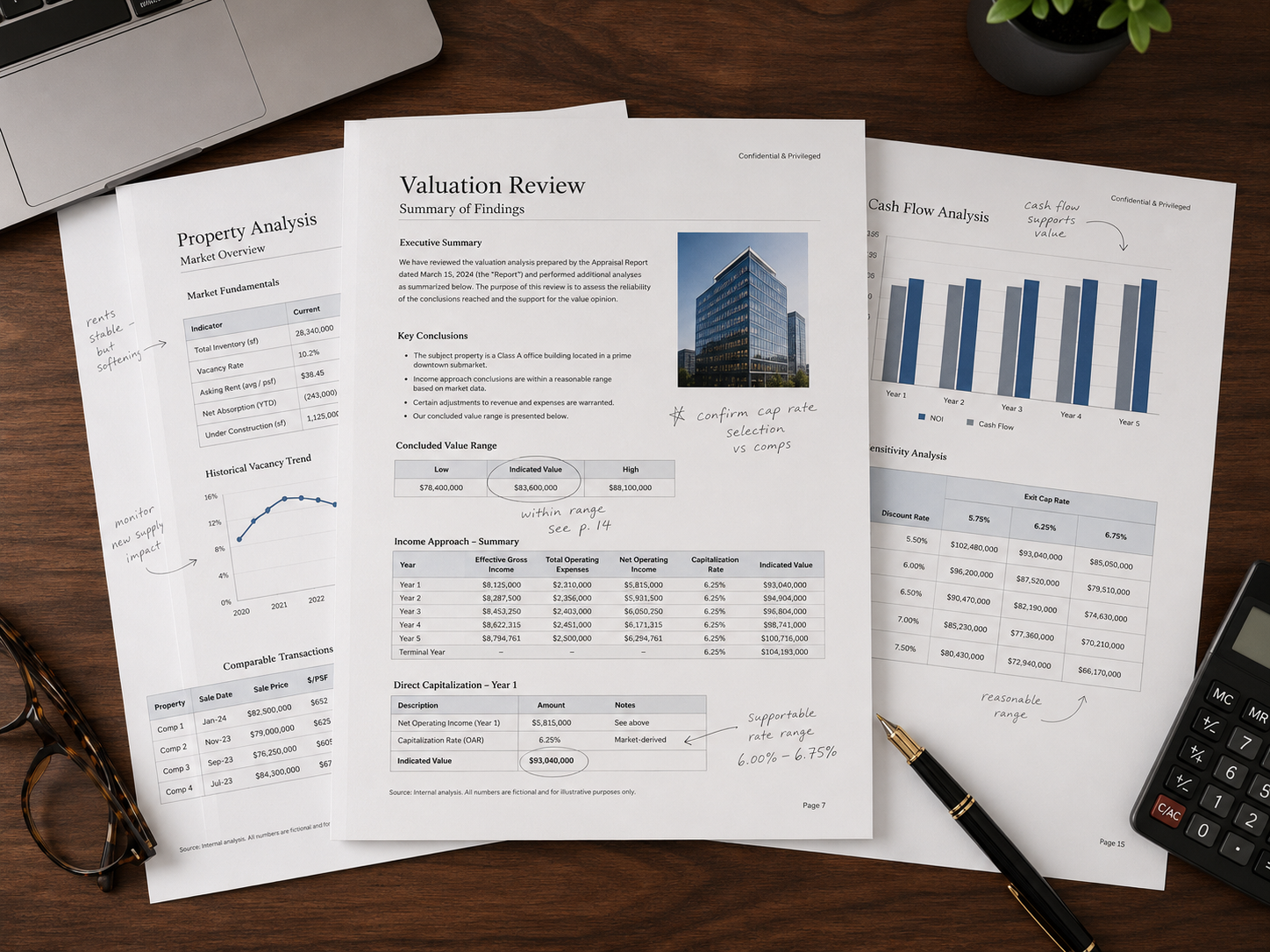
The value of a preliminary technical review
A preliminary technical review can help answer several important questions before the litigation path is fully set.
For example:
Is the valuation concern real, or is the existing value defensible?
Are the assumptions consistent with the facts?
Is the valuation date evidence strong enough?
Are the selected comparables appropriate?
Has the income approach been applied properly?
Are capitalization rates, vacancy assumptions, expenses, or market rents supportable?
Is highest and best use being misunderstood or overstated?
Is the issue legal, factual, valuation-based, or some combination of all three?
Would a full expert report likely assist, or would it simply confirm what is already apparent?
In some cases, the answer may be that the client has a strong issue and should proceed. In other cases, the better advice may be that the valuation is probably reasonable, the appeal is unlikely to succeed, or the cost of fighting is disproportionate to the potential result.
Sometimes, the answer is that the valuation is wrong, but not in the direction you are hoping. Over the years I have lost count of the number of clients I have had to tell, “I know you think you are over-taxed, but for the following reasons you are actually under-assessed. The last thing you want is an assessor walking around in here.”
That may not be the answer a client hopes to hear. But it can be the most valuable advice in the matter. It is far better to learn early that what appears to be an opportunity may actually be a significant exposure.
Helping counsel prepare better questions
One of the most practical benefits of a non-testifying consultant is assistance with expert report review and cross-examination planning.
Valuation reports can be difficult to challenge effectively. A report may be lengthy, technical, and filled with terminology that sounds authoritative. But the strength of a valuation opinion often depends on a small number of critical assumptions.
The useful question is not simply:
Where is the opposing expert wrong?
It is also:
Where is the opposing expert vulnerable?
And just as importantly:
Where is the other expert strong?
Poor cross-examination can make a weak opinion look stronger. A technical attack that is not well understood can give the expert an opportunity to explain, reinforce, and rehabilitate their conclusion.
Early valuation litigation support can help counsel identify which issues are worth pursuing, which should be left alone, and which questions need to be asked carefully.
Settlement strategy also depends on valuation judgment
Many valuation disputes settle. That does not make valuation analysis less important. It makes it more important.
A party cannot settle intelligently without understanding risk.
In a property valuation dispute, that risk may involve more than one number. It may involve a range of possible outcomes, evidentiary weaknesses, uncertainty in the market data, the credibility of competing approaches, and the way a tribunal or court may respond to the expert evidence.
In portfolio matters, the stakes may be even higher. One settlement can become the framework for multiple properties or future years. A narrow technical issue in one file may have broader implications elsewhere.
A non-testifying valuation consultant can help counsel and clients understand the likely settlement range, the risks of proceeding, the weaknesses in their own case, and the pressure points in the other side’s position.
This is not a substitute for legal advice or expert evidence
Non-testifying valuation support is not a substitute for legal advice. It is also not a formal appraisal or expert report unless the consultant is specifically retained for that purpose.
The role is different.
The purpose is to help counsel and clients understand the valuation issues, test assumptions, identify risk, and make better decisions about litigation, settlement, and expert evidence.
In some matters, the best next step will be to retain a fully independent testifying expert. In others, the early review may show that the issue is narrower than expected, that the case is not worth pursuing, or that settlement should be approached differently.
The key is to bring the right expertise into the file at the right time and in the right role.
The right expert, at the right time, in the right role
In complex valuation disputes, the first expert call can shape the entire file.
Sometimes that call should be to the person who will ultimately give evidence. But sometimes it should be to someone who can help counsel understand the terrain before the independent expert is retained, before the litigation theory hardens, and before time and money are committed to the wrong issue.
A non-testifying valuation consultant can help identify whether there is a real issue, where the evidence is strong, where it is vulnerable, and what kind of expert evidence may actually be needed.
That early clarity can be valuable.
It can help avoid weak cases.
It can strengthen good ones.
It can protect expert independence.
And it can help counsel make better strategic decisions in disputes where valuation evidence may determine the result.
HCALS provides valuation litigation support in complex property assessment, municipal taxation, commercial real estate, redevelopment, and other property valuation disputes.
For counsel or clients dealing with a complex valuation issue, early technical review may help determine whether the issue is real, material, and worth pursuing.
Contact HCALS to discuss whether early valuation litigation support may assist.